

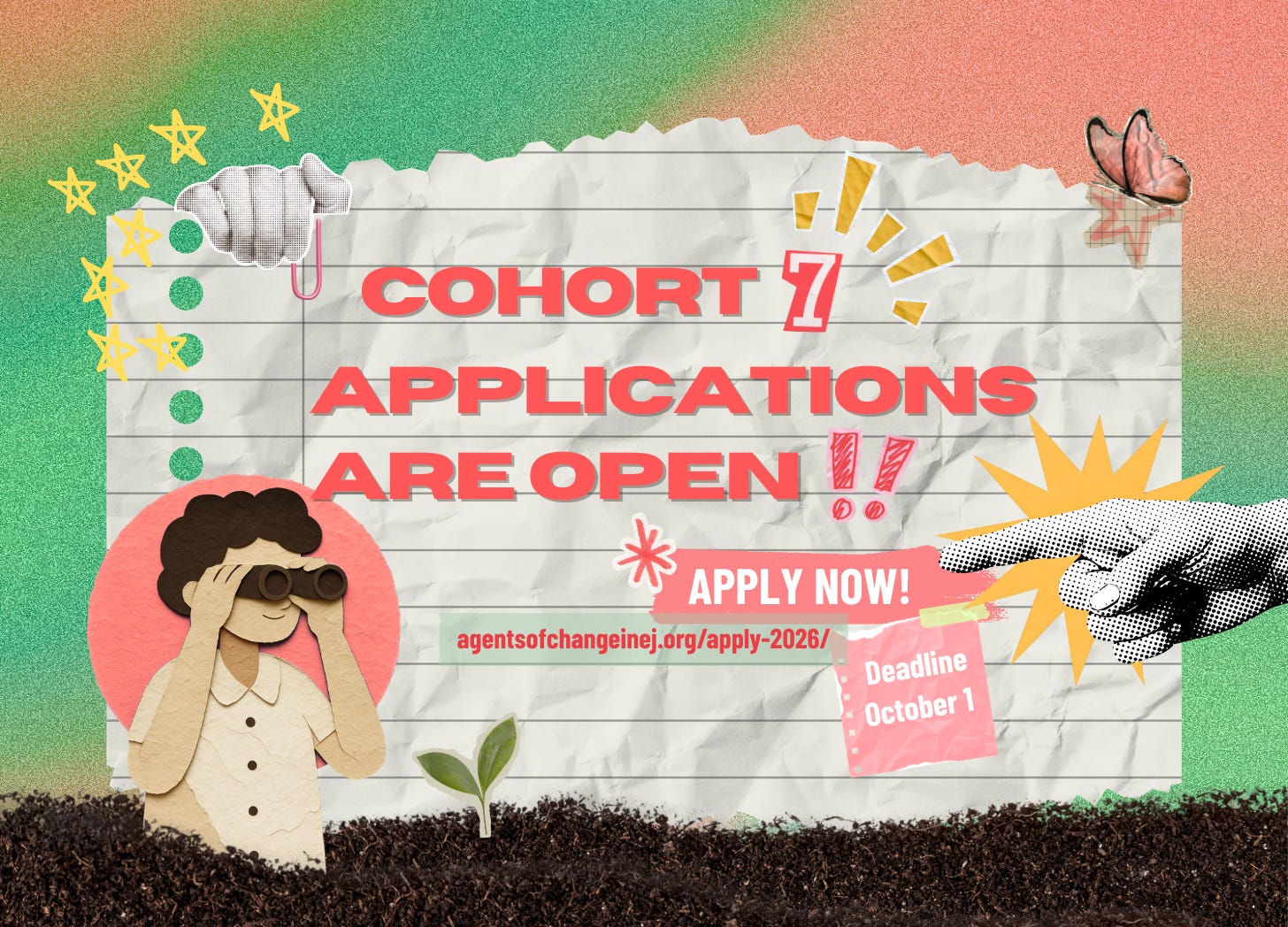
Applications for Cohort 7 are open! Here’s everything you need to know.
It's time to tell you exactly what you'd be signing up for.

Every year, we watch brilliant researchers do exactly what they were trained to do: publish, present at conferences, apply for grants, wait for the citations to add up. And every year, we watch the same gap open up between that work and the rooms where decisions about air, water, and land actually get made.
That gap is what Agents of Change Cohort 7 is built to close.
If you’ve been reading our posts, telling yourself you’ll get to it, and wondering if you’re the right person, this piece is for you. We’re walking through exactly what the fellowship asks of you, what you walk away with, and who thrives here.
Who we’re looking for
We want U.S.-based early-career scientists — in academia, government, or nonprofits — doing work on environmental public health, environmental justice, or climate health and justice. International researchers at U.S. institutions: you’re eligible too, although you might not be able to receive a stipend depending on your Visa type1
Past fellows have worked on air pollution, toxics, plastics, water quality, food systems, the built environment, Indigenous environmental rights, and increasingly, energy and data centers. We cast our net wide because we believe environmental harm doesn’t sort itself neatly by issue.
If you’re familiar with our program, you’ll notice a slight shift. If before we scoured for early-career researchers with strong science, today we’re looking for people who already know who they’re trying to reach.
The strongest applications come from people already talking to a city council member, a state legislator’s staffer, a local health advocacy group. If you can name the person or the room your research needs to get into, you’re exactly who Cohort 7 is built for.
A few examples of who fits:
A scientist working for an NGO studying groundwater contamination who’s already been asked to testify before her state’s water board.
An assistant professor modeling how a proposed data center’s water and energy demand would strain local supply, partnering with a local advocacy coalition preparing to intervene in the county’s permitting process.
A PhD student mapping heat exposure in outdoor workers, working alongside a farmworker justice organization pushing for a state labor standard.
If you haven’t started those conversations, don’t rule yourself out. But come ready to tell us exactly where you want them to start, and with whom.
What the year actually looks like
Our fellowship adds up to 80-100 hours over the course of a year, for which you will receive a $3,000 honorarium.
It opens and closes with two in-person retreats (2-4 days each) where you meet the rest of your cohort and start working with people who’ve already built the kind of bridge you’re trying to build.
In between, the work settles into a rhythm of online workshops and one-on-one mentorships to work on two projects:
A policy roadmap and engagement plan: a 1-2 page landscape analysis breaking down a state or local policy or initiative addressing an environmental or climate justice issue you care about. You’ll figure out who’s already involved, where the initiative stands, and where the openings are for your research to shape what happens next. You’ll then spend a couple months engaging with the folks who are involved and write a reflection of your experience.
A personalized engagement strategy: your roadmap for who you’re trying to reach and how, anchored by one communications deliverable that puts your research into action (a policy brief written for the person who’ll act on it, or an op-ed placed with an outlet that reaches the audience you’re trying to move), plus a short-form social video that carries that work to a wider audience.
Both are required to complete the fellowship. We want you to end the year with a clear understanding of how to bring your science out of your lab, with something you use, and something other people see.
What you get that you can’t get anywhere else
We’re based at Columbia’s Mailman School of Public Health, under the direction of Dr. Ami Zota. However, this work will allow you to go beyond academia:
A cohort of peers doing the same translation work, in the same year. You’ll end up being part of a community of more than 50 leading environmental health researchers.
Direct, personalized mentorship from scientists and communicators to build the bridge between a lab and a legislature.
Access to a platform built to put your work in front of people who can act on it, or who can connect you with those who can.
If you’re on the fence
If you’re still wondering “I’m not a policy person. I don’t have connections yet. My research feels too early-stage”, don’t rule yourself out! The fellowship exists because most scientists were never taught this, and that’s the whole point of the training.
To answer any remaining questions, join our LinkedIn Live on August 20, where a past fellow and our director, Dr. Ami Zota, will answer them in real time.
Register here → https://www.linkedin.com/events/7490504278927826944?viewAsMember=true
Applications close October 1, 2026.
Apply now at https://agentsofchangeinej.org/apply-2026/
See Columbia’s Finance Office Allowable Payments for Visa types here.