What the body holds (how to carry a dimming light)
A dwindling sight showed a microplastics researcher that a vision for our future was never only about the evidence in front of our eyes.


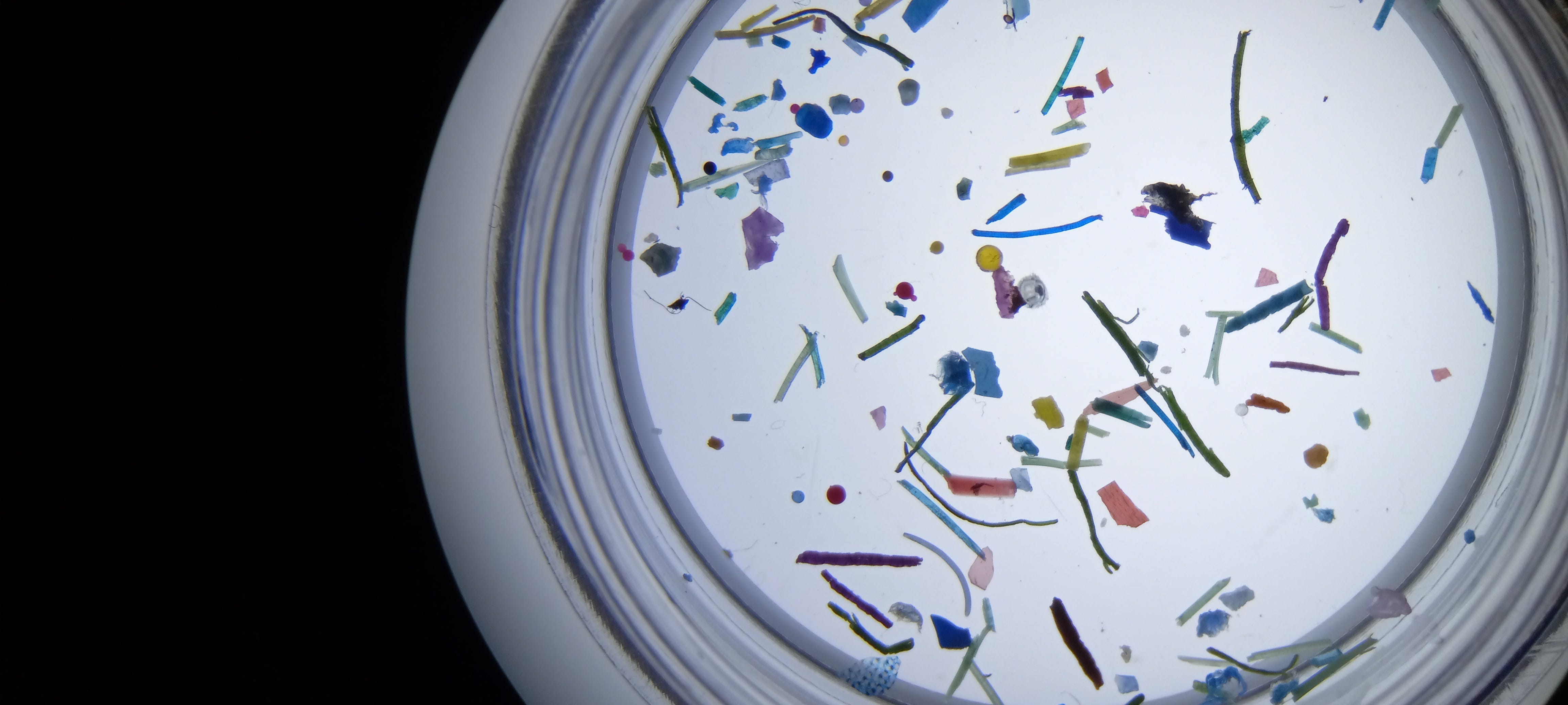
Our Fellow in Residence Timnit Kefela is an environmental scientist who has spent a decade studying microplastics and the communities who bear the cost of a pollution crisis they didn't create. In this guest essay, she turns a rare diagnosis into a reckoning with everything her field already knows — and refuses to do.
What the body holds
(how to carry a dimming light)
A dwindling sight showed a microplastics researcher that a vision for our future was never only about the evidence in front of our eyes.
It felt insignificant at first.
A pain that lived somewhere behind my eyes since I was eleven – dull, then sharp, then gone – that every doctor I had seen quietly handed back to me, unexplained or dismissed as stress or lack of sleep. I chalked it up to the microscope hours, the new lab, the long days counting small colorful bits of plastic. The sharp lines felt softer. The blur must have been exhaustion.
I have spent the last decade trying to understand how plastic, the material that builds our homes, wraps our food, runs through our infrastructure, breaks down into small particles that nest in lung tissue and makes homes in the stomachs of birds. Microplastics are almost everywhere now, in our soils, waters, air, fellow organisms. In us. But their scale is an excellent hiding place. We measure impact in our tissue samples, sediment and soil cores using the sanitised language of accumulation like parts per million or mass per mass. Our words obscure the experiences of communities who live inside those numbers, that the data we analyze circles without saying it directly: this is not happening equally. The places absorbing the most impact from a plastic’s lifecycle are rarely the places that profit from them.
Take synthetic textile waste, which are primarily plastics. Countless stories have been written about how microfibers rain on national parks, how dryers and washing machines shed pounds and pounds of these plastics into our waterways and soils. But few have been written about places like the Dandora dumpsite in Kenya, where waste management is primarily open burns of accumulated layers of materials that originated elsewhere and can neither be separated nor repurposed. The air is almost always acrid, thick and lingering – an end-of-life fate that for many is unfathomable of the original wearers of the clothing, begging the question why do certain places become the recipient of another’s consequences?
I have lived inside this question for a long time. It is how I became an environmental scientist who spends hours pressing my eyes to the lens, learning to understand what people cannot easily see. There is an intimacy in studying what is invisible but felt. You train yourself to slow down, to look longer, to steady your hand and trust what the instrument shows you even when it defies your expectation. I have spent the last ten years training my eyes to find what cannot be easily seen.
But now my sight is leaving me. In 2024, I was diagnosed with Vogt-Koyanagi-Harada Syndrome, a rare autoimmune disorder that causes, among other things, temporary –and, if left unaddressed, potentially permanent– loss of vision. After it first happened, I was terrified. But with time, I started to look closely at this cryptic, invisible force guiding my body to attack itself. And I’ve found intimacy here, too. I’ve seen a world of metaphors unfold.
What I’ve seen is how vision has never truly been only about eyes. It is about what a society deems is worth witnessing, who it trusts to look, and what it does with what it finds. We have built entire systems, be it regulatory, economic, political, that are structurally oriented away from evidence. It is not because the evidence is weak, but rather looking directly at the barrel of guns would require changing everything upstream of it – which is hardly profitable or convenient.
A chosen blind spot
Spending extensive time in ophthalmology and rheumatology waiting rooms, I learned about a word that I feel best describes our reaction to the rate of policy formation and governance around plastic pollution – a scotoma. A blind spot, which occurs not because of an absence of light but a failure of the brain to process what the eye is receiving – the signal arrives, the images do not form.
Our inaction towards plastic pollution is not because of a failure of information, or hidden evidence.
I think about my own diagnosis often in relation to this type of blindness. The pain was there for decades before anyone took it seriously. It was often written off as I had not slept enough. Or to the chagrin of a former partner, maybe it was in my head, maybe I could think it away. My symptoms were documented, handed back and filed away. The system was not necessarily lying to me, but it just was not looking. There is a difference between the absence of answers and the absence of attention, because I would not say that my doctors were malicious per se, they were busy, likely undertrained in what they were seeing, and shaped by a medical culture that prioritizes addressing symptoms efficiently (this is not an episode of “House” after all, but it is a rare disease that would have made for a fascinating episode).
Likewise, our inaction towards plastic pollution is not because of a failure of information, or hidden evidence. It has been published, presented, submitted and testified with. My colleagues who study endocrine disruption have been publishing findings on the hormonal impacts of plastic-adjacent chemicals for over two decades. Researchers tracking microplastic concentrations in freshwater systems have watched the numbers climb in a nearly unbroken line. Pediatric health scientists have been raising alarms about early childhood exposure before I entered this field. It is a growing mountain that we are patiently waiting for consensus to summit, with a need for more data or better measurement techniques, which, sure, we can always have more and better.
Our regulatory bodies are no different, responding at a pace that does not match the urgency needed. The Global Plastics Treaty, which should have established a binding international cap on plastic production and pollution, has stalled in negotiation cycles while industry representation outnumbers environmental delegates and concerned observers at the discussion table. Voluntary pledges from major producers promising to reduce single-use plastics, invest in environmentally sound alternatives and clean up supply chains have largely gone unmet or unmeasured. The promising intergovernmental and science panel on chemicals, waste and pollution (ISP-CWP) still lacks the foundational aspects to be a functioning international governance body.
I watch this unfolding catastrophe and I see a reckoning – a constellation of everything few manufactured for profit at a cost the many never consented to bear.
People often ask what I can no longer see. I tell them at first it is the edges of things. The periphery goes first; the color fades and the center slowly follows. It feels like a metaphor for those of us who are left in the margins of plastic pollution conversations but bear witness to the heart of its impact. The communities most burdened by plastic pollution have always understood that this is not a knowledge problem. It never was. It is a question of who is considered worth protecting, whose future counts as a future worth preserving, whose body is treated as a threshold worth defending. Fenceline communities have been documenting changes in their waters, fish, bodies, for generations through oral histories tinged with tonal grief of the land being corrupted. The data is not lacking, but rather the audience that is willing to receive it as legitimate embodied knowledge is. This is what it means to choose not to see. It’s a particular kind of blindness that is intentionally chosen and hardly medical.
What is missing is the willingness to disrupt using that data. The problem has been a profound, practiced, institutional refusal to let what is seen become what is acted upon. In part, that’s because as a scientist, you are trained to sit with uncomfortable findings and resist the instinct to explain them away. But this moment requires something different of all of us. It asks us to commit to community care, to a livable future, and look at what is already here and stop rationalizing the blur.
My sight is leaving me. But the urgency to address what it has shown me does not leave with it.
.
 | A guest post by
|
Thank you. As a fellow researcher, your words took my breath away. We need to convey this crisis through these types of stories. Best wishes to you, and, again, thank you.
Such a beautiful piece by such a brilliant person