The Midwest's queer climate crisis, finally measured
New research out of Ohio is among the first to put hard numbers on what queer communities already know: when disaster hits, they are not equally protected.

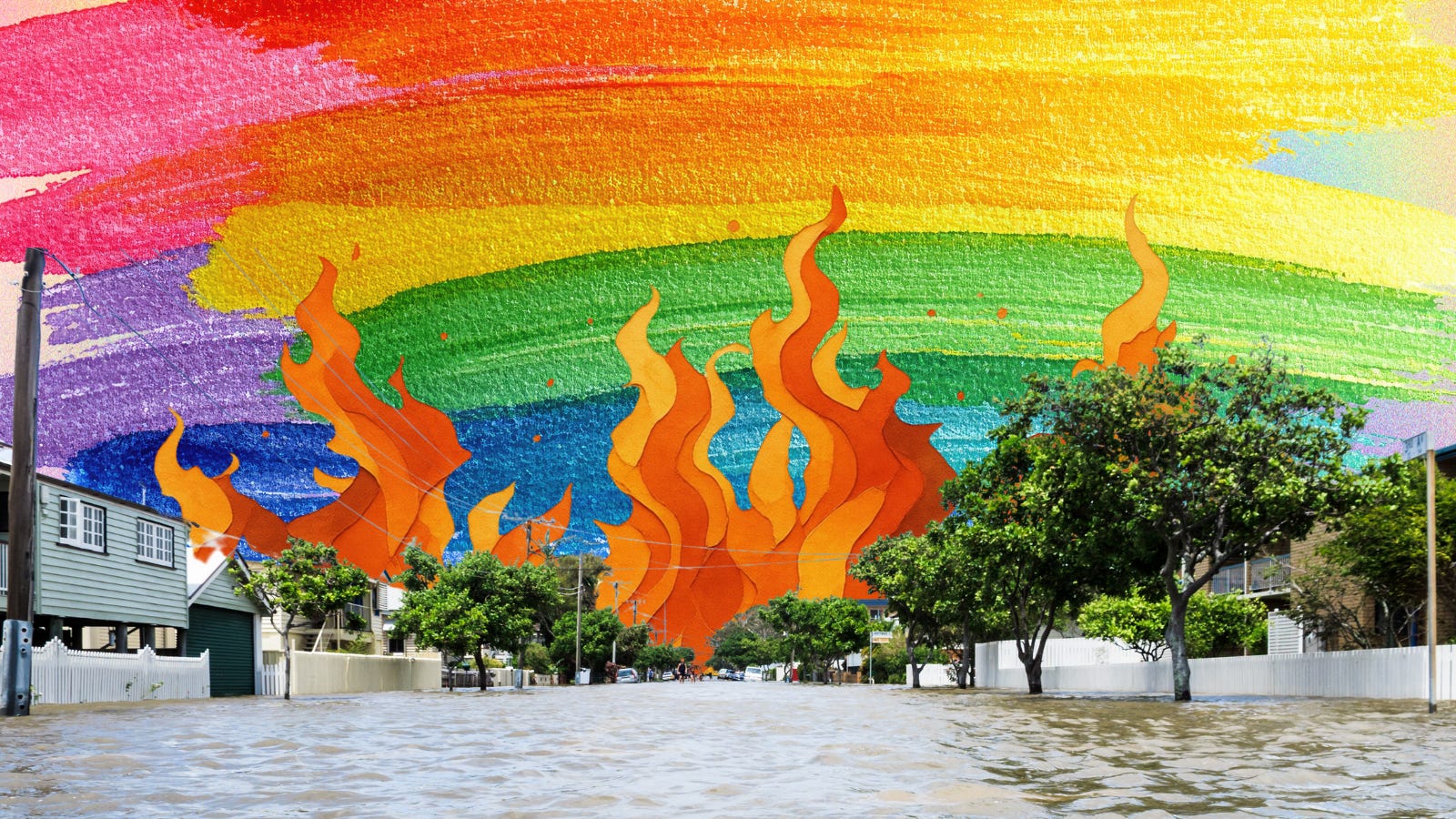
Pride is a month of celebration. It’s also, increasingly, a month of record heat. The two are not unrelated: the marginalization that shapes queer lives in ordinary times doesn’t pause for a disaster. It compounds.
Queer people face higher rates of unemployment and poverty than cisgender straight individuals, and transgender people face the highest rates of all, explains Brandon Rothrock, co-author of a new study on queer communities and extreme weather in Ohio. The poverty rate among transgender people sits at 29.4%, and up to 64% earn less than $25,000 a year. As a result, they often end up in lower-quality housing with inadequate climate control, poor weatherproofing, and locations in flood-prone areas. And when a disaster hits, the systems meant to catch everyone often leave them out.
Queer people are often turned away from faith-affiliated shelters, feel unwelcomed if they do get in, or are denied recovery during rebuild, as happened to same-sex couples after Katrina, who weren’t recognized as families under FEMA’s definition and were sometimes resettled in different cities.
“All those sorts of factors come together to make LGBTQ populations more vulnerable in everyday spaces,” says Rothrock, “and then that sort of transfers over into these disaster spaces.”
Rothrock is a third-year PhD candidate in geography at Ohio State University. The research connecting queerness and climate disasters is still in its infancy, the first study on the topic came out in 2008, and the Midwest, where Rothrock has focused most of his work, is practically a blank page. Ohio makes a revealing case study: the state is home to an estimated 557,600 LGBTQIA+ adults, has no statewide anti-discrimination protections in employment or housing, and is on the Human Rights Campaign’s list of high-priority states for basic equality. It’s also getting wetter and hotter. Parts of the state have already recorded a 36% increase in rainfall during heavy precipitation events, and Midwest temperatures are projected to rise 3 to 5°F by mid-century.
Yet “there’s just not much research coming out that describes how people will be affected by those issues,” he says.
He wanted to fix that. Most of what exists in this field is powerful qualitative research that helps understand why this happens, but is unable to fully establish the scope of the issue. His team set out to change that with hard numbers.
Working with the Rainbow Resilience Research Group, an interdisciplinary team spanning geography, social work, and civil engineering, his team surveyed 882 LGBTQIA+ adults across Ohio about their experiences with flooding and extreme heat over the past five years. The result is one of the few quantitative studies in a field that has operated almost entirely on qualitative evidence.
The findings are striking. Transgender respondents were the most exposed of anyone in the survey: more than twice as likely as cisgender men to have their home flooded, three and a half times more likely to suffer health consequences from flooding events, twice as likely to be trapped in heat they couldn’t escape, and nearly four times more likely to get sick from it. People living with both physical and mental disabilities were also significantly more at risk from extreme heat, as were people living in cities, where temperatures run hotter and relief is harder to find.
Rothrock wasn’t surprised by the pattern. “Just being LGBTQ+ comes with a lot of vulnerabilities, on a social and sort of physical level in the U.S. And all those sorts of factors that come together to make LGBTQ+ populations more vulnerable in everyday spaces, then transfer over into these disaster spaces.”
One finding surprised even the researchers, however. Higher-income LGBTQ+ respondents had greater odds of flooding displacement than those earning under $30,000, the opposite of what poverty research typically predicts. “That was really interesting,” Rothrock said, “because thinking about poverty, it typically increases people’s exposure and vulnerability to climate change issues.” If he had to guess, Rothrock says, lower-income renters may live in apartments where flood damage goes unnoticed, or lack the resources to move even when they’d want to. But he’s clear this warrants more research.
Beyond vulnerability
Research on LGBTQ+ people and disasters tends to pull in two directions at once: documenting profound vulnerability while marveling at community resilience. Rothrock thinks that framing flattens something important. “I feel like a lot of work needs to not be two sides, but sort of in the middle of that.”
His ongoing interviews on queer mutual aid following Hurricane Helene put texture on that nuance. He described someone in the Florida Panhandle who, days after the storm, loaded a box truck with supplies and drove to Tampa to help sixty strangers. In western North Carolina, someone with running water spent days doing laundry for residents of a disabled elderly complex that had lost water for weeks, coordinating over Signal from their e-bike. The capacity to show up for others first requires having enough yourself. Not everyone had that luxury.
Rothrock is already working on what follows: a second paper on the intersection of transgender identity and disability in the same dataset, and a dissertation on queer and disabled people in Appalachian nonprofits thinking through energy transition. As someone who identifies as both disabled and LGBTQ+, the question isn’t abstract.
“I’m interested in the other side of disability and climate change as well, thinking aboutthe accessibility to disaster services, the inaccessibility of housing in the US, and how certain government agencies are not thinking about the issues that disabled populations experience before, during, and after disasters.”
You can read the full study here: Flooding and extreme heat experiences among Ohio’s queer communities: Learnings from a regional survey in the United States, published in Population and Environment (2026).