The hair products available to you depend on where you live — and who lived there before you
A new study of nearly 40,000 hair products finds that decisions made nearly a century ago still shape what ends up on beauty store shelves across Boston— and how safe it is.


Roxbury and Beacon Hill sit a few miles apart in Boston. But a few miles can change everything: while the mostly white residents of Beacon Hill’s brick row houses live on a median household income of around $147,000, the mostly Black and Latino residents of Roxbury make roughly a third of that. Walk into their beauty supply stores, and you’ll spot the difference even on the hair care products on the shelves.
A new peer-reviewed study published in Environmental Epidemiology shows that in Boston, where you live — and specifically, the history of investment and disinvestment in your neighborhood — is a powerful predictor of whether you can easily find safer, low-hazard hair products nearby.
“The main finding from this paper was the fact that we saw differences in access to safer hair products when looking at areas that were historically redlined and gentrified,” says Dr. Marissa Chan, a postdoctoral research fellow at Columbia Mailman School of Public Health, and lead author of the paper. The research builds on her earlier work exploring how socioeconomic and racial disparities shape the personal care products available in Boston neighborhoods.
What are redlining and gentrification?
Decades of research show that neighborhood-level forces shape what goods and services are available to residents — from the supermarkets in your area (or the lack of them) to the green space nearby. In the United States, two of the most powerful forces shaping cities are redlining and gentrification.
Both, Dr. Chan explains, are resource allocation practices. That means they’re “decisions that were or continue to be made by both public and private entities in terms of what communities should or should not receive certain investments or resources.”
Redlining was a legalized form of structural racism in the 1930s, carried out by the Home Owners’ Loan Corporation (HOLC). Neighborhoods predominantly made up of lower-income residents, communities of color, and immigrants received a grade of “D” — labelled “hazardous” on maps and shaded in red. Wealthier, predominantly white neighborhoods got an “A.” As a consequence, redlined communities were cut off from access to lending, homeownership, and wealth-building for generations.
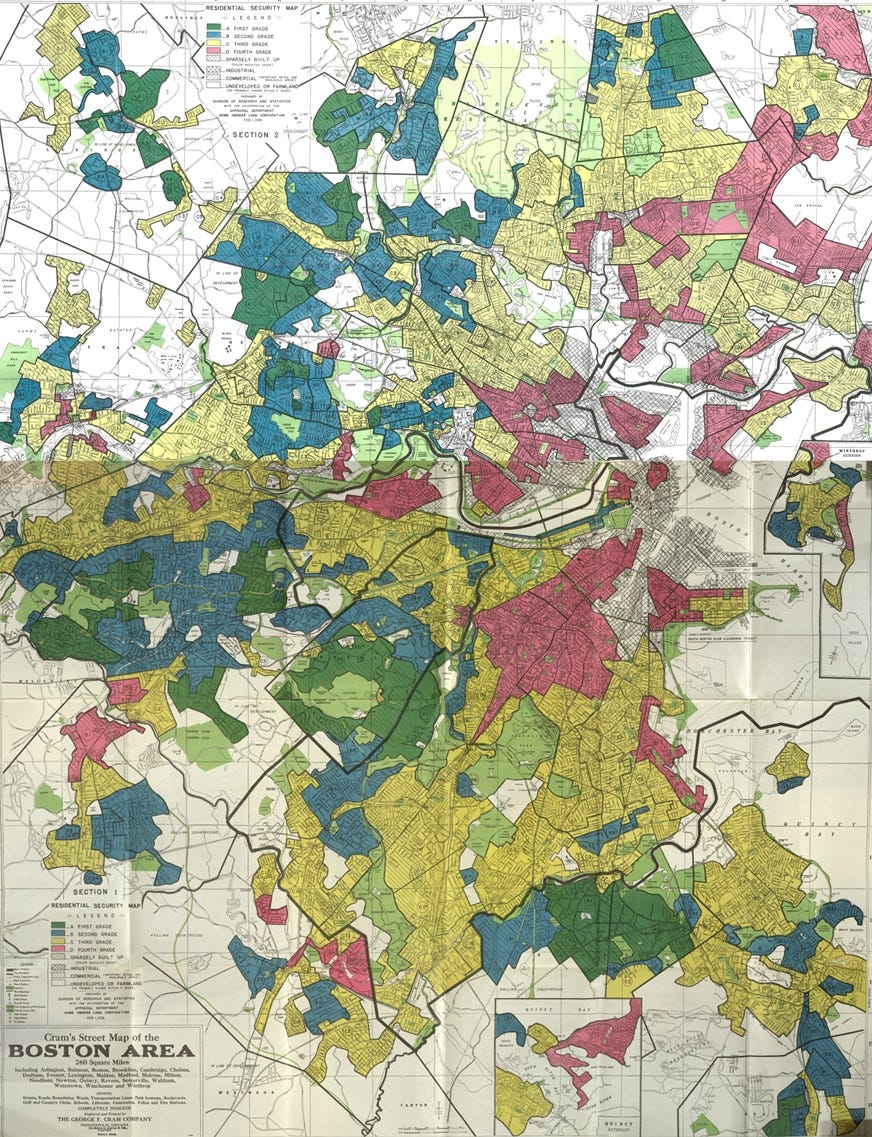
Redlining also impacted a neighborhood’s access to quality products. Things like quality grocery stores, pharmacies, and diverse retail were limited, and the legacy remains. Today, even when chains do open in previously redlined areas, their stores are dirtier, have fewer staff, and disorganized inventory. And, as Marissa’s research found, it also defines the products available on the shelves.
Gentrification is a more contemporary process. As Chan describes it, is when “typically higher income and predominantly younger folks move into lower income areas, and through reinvestment and rising housing prices, the original lower income communities may be displaced.” You might recognise it as the fancy coffee shop in the corner that used to be a bodega.
These two forces don’t operate in isolation. Some neighborhoods were redlined decades ago and are now gentrifying. Others have experienced what Chan calls “prolonged resource deprivation” — historically redlined and still not gentrified today.
And both forces are present in the results.
What the paper found
Chan and her colleagues visited 117 stores across all 24 Boston neighborhoods, cataloging nearly 40,000 hair products and rating their safety using the Environmental Working Group’s Skin Deep database, which scores products on a hazard scale from low (0–2) to high (7–10) based on the presence of chemicals like endocrine-disrupting chemicals (EDCs), formaldehyde, and other compounds of concern.
They found areas experiencing prolonged resource deprivation — historically redlined and not currently gentrifying — had significantly more high-hazard hair products on shelves and fewer low-hazard ones when compared to historically wealthy areas and gentrified ones.
The researchers also found differences in product safety across locations of the same pharmacy chain operating in different neighbourhoods — a pattern researchers call “retailer redlining,” where stores stock and market different products depending on the community they serve.
Some might ask: can’t people just buy products online? Chan pushes back on that.
“Even though there has been a large shift towards purchasing products online, research is really finding that around 60% of folks are still purchasing their products in stores.”
Moving toward solutions
Hair products are a documented source of exposure to endocrine-disrupting chemicals, and Black women face disproportionate exposure because of higher use of leave-in products, hair oils, and relaxers that are more likely to contain EDCs, which have been linked to increased risk of adverse health outcomes, including reproductive impairment and cognitive issues in children.
For Chan, the deeper point of this work is about where we place responsibility.
“This really illustrates how we need to move upstream, away from individuals and consider how retailers, how other neighborhood-level characteristics, and even beyond that, how societal norms and policies may impact product use and health. And so when we start moving upstream, we have the potential to impact more populations at risk,” she explains.
She’s also clear that solutions have to be built with communities, not just for them. “It’s also critically important that we ask our community members and ask the folks that we work with at the community level what they view as important in terms of solutions.”
Dr. Chan’s research makes the case that unequal access to safer hair products is the result of decades of policy decisions. Fixing it will require just as deliberate decisions.
You can read Dr. Chan’s paper here: Clean beauty gentrification: The role of historic and contemporary resource allocation practices on hair product safety in Boston, MA
This work builds on her first paper exploring hair product safety across Boston neighborhoods: Evaluating neighborhood-level differences in hair product safety by EWG ratings among retailers in Boston, MA
I know very little about black hair products, other than they can be REALLY dangerous. Good info. Think I will stick with my rosemary, lavender and mayo mask. Its disgusting to look at, but in a pinch, one can spread it on a sandwich. Kidding, but why not?